
How Educational Games Help Build Critical Thinking Skills
Educational games are often viewed as a fun way to keep children engaged, but their benefits go far beyond entertainment. When designed with learning objectives in mind, games can help children develop critical thinking skills that support success both in school and in everyday life.
Critical thinking is one of the most valuable skills a child can develop. It helps children analyze information, evaluate different solutions, make decisions, and solve problems independently. Educational games create opportunities for children to practice these skills in an engaging and interactive environment.
What Is Critical Thinking?
Critical thinking is the ability to think carefully and logically about information rather than simply accepting it at face value. It involves asking questions, identifying patterns, comparing options, and making informed decisions.
Children use critical thinking when they solve puzzles, answer challenging questions, build structures, follow instructions, or work through a problem step by step.
Unlike memorization, which focuses on remembering information, critical thinking focuses on understanding and applying knowledge.
Why Educational Games Work
Educational games encourage active participation. Instead of receiving information passively, children become part of the learning process.
Many educational games require players to:
Analyze situations
Make decisions
Test different solutions
Learn from mistakes
Adapt their strategies
These activities help strengthen logical reasoning and problem-solving abilities while keeping children motivated to continue learning.
Because games provide immediate feedback, children can quickly understand what works and what does not, allowing them to improve through practice.
Learning Through Challenges
One of the most effective ways to develop critical thinking is through challenges.
When children encounter obstacles during a game, they must think carefully about how to overcome them. They learn to break larger problems into smaller steps and evaluate different approaches.
This process teaches valuable skills such as:
Persistence
Creativity
Decision-making
Strategic thinking
Independence
Each challenge becomes an opportunity to learn rather than a fear of making mistakes.
The Importance of Learning From Mistakes
Mistakes are an essential part of learning.
Educational games create safe environments where children can experiment without fear of failure. If a child answers incorrectly or chooses the wrong solution, they can try again and learn from the experience.
Research shows that this type of feedback helps children develop resilience and confidence. Instead of giving up when something becomes difficult, they learn to approach challenges with curiosity and determination.
This mindset supports long-term academic growth and personal development.
How Technology Can Support Critical Thinking
Modern educational technology offers new opportunities for interactive learning.
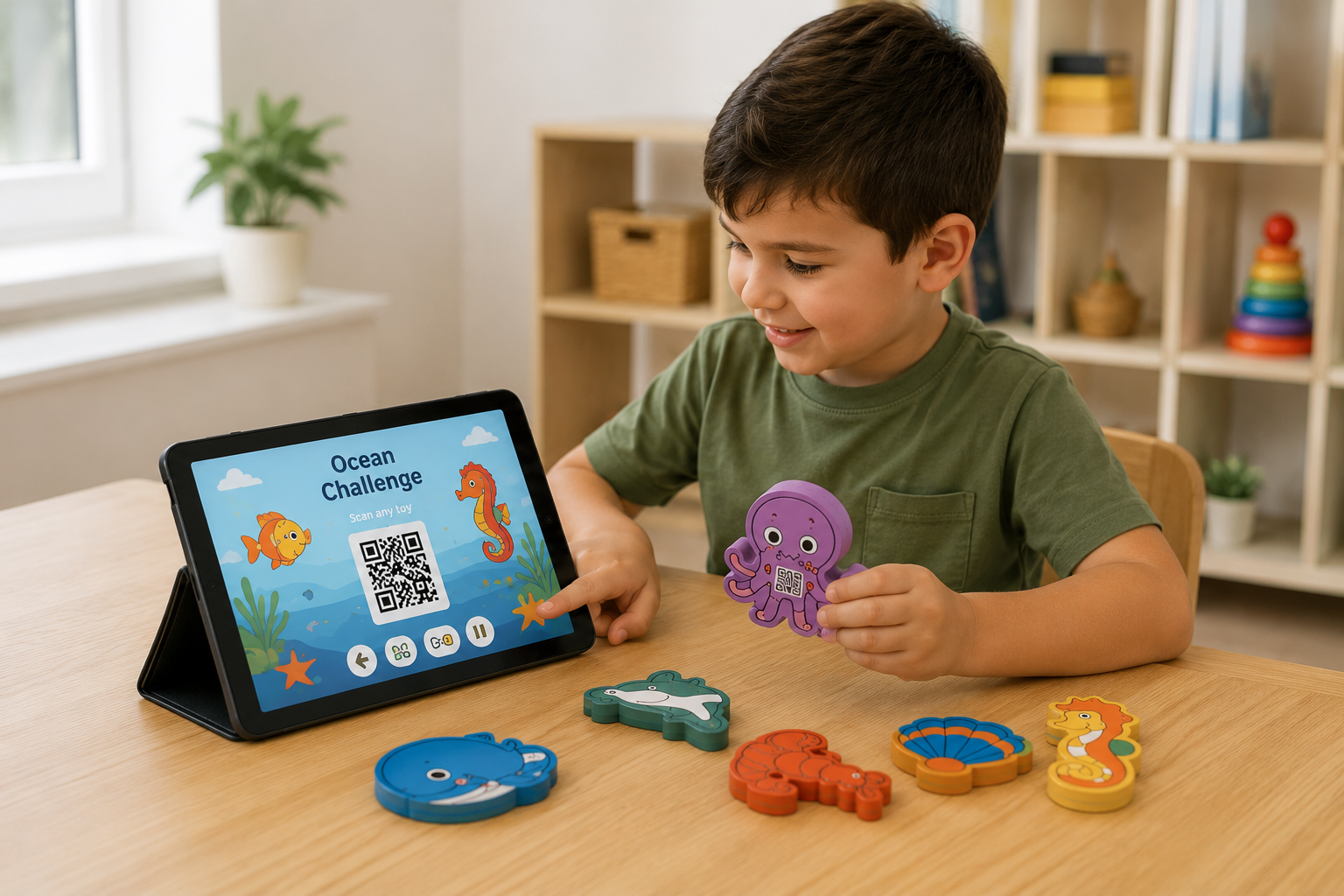
Educational apps, digital quizzes, problem-solving activities, and QR-based learning experiences can encourage children to think actively rather than simply consume information.
When technology is combined with meaningful educational content, children can practice critical thinking in ways that feel natural and enjoyable.
The goal is not more screen time.
The goal is better learning experiences that encourage exploration, discovery, and understanding.
Bringing Learning and Play Together
Children are naturally curious. They enjoy exploring, asking questions, and discovering how things work.
Educational games take advantage of this curiosity by transforming learning into an engaging experience.
By combining educational objectives with interactive activities, children remain motivated while developing important life skills such as critical thinking, communication, creativity, and problem-solving.
When learning feels like an adventure, children become active participants in their own education.
Conclusion
Educational games are much more than entertainment. They provide children with opportunities to develop critical thinking skills that will benefit them throughout their lives.
By encouraging exploration, decision-making, and problem-solving, educational games help children become more confident learners and independent thinkers.
The most effective learning experiences happen when education and play work together, creating opportunities for children to learn, grow, and discover the world around them.